
By Brian Jones, Chief Operating Officer, Envision Financial Systems
The hardest problem in alternative investing right now is not the product. It is the plumbing. Ask the people who run fund operations what slows growth, and the answer is rarely a missing fund type — it is the lack of a shared way to move investor and transaction data between the parties who need it. Product structures change quickly, but the operating questions underneath them do not.
Three forces are converging on the transfer agent at once: a new generation of investors who expect digital, real-time experiences; asset managers under pressure to cut costs and simplify how many providers they manage; and technology — AI, tokenization, and distributed-ledger rails — that is changing what the infrastructure can do. Each force is usually presented on its own; however, their significance becomes clearer when viewed together because they all lead to the same place.
That is why any serious view of the future transfer-agency market has to start with the transfer agent itself and the core systems supporting it. The transfer agent is no longer just an administrative processor at the end of the fund ecosystem whose cost needs to be managed. It is becoming a strategic platform at the intersection of product, operations, distribution, servicing, and investor experience. It is also the connective infrastructure that drives digital investor experiences, consolidates operating models, enables AI-driven data use, and makes new settlement rails practical. In that sense, the Transfer Agent and its core recordkeeping system is not a back-office detail; it is one of the critical drivers shaping how the market evolves.
That strategic role matters because transfer agents maintain some of the most important investor and transaction data in the asset management ecosystem. The data can inform product development, servicing strategy, operational optimization, and investor engagement. Performance may drive initial product selection, but the ongoing investor experience often determines long-term satisfaction, loyalty, and retention. That experience is shaped not only by the digital tools’ investors see, but by the workflows, servicing model, and data access that sit inside the transfer-agency function.
Where each shift actually lands
The visible layer — portals, dashboards, blockchain headlines — gets the attention. But every one of these shifts ultimately becomes a demand on the recordkeeping system beneath the transfer agent. The table below traces each force from what changes for the transfer agent to what it requires of that system.
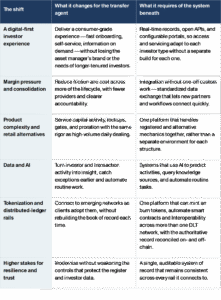
If you read down the right-hand column, the same requirement keeps surfacing: the system has to be open and connective — API-first, in the language the rest of technology adopted a decade ago — rather than a set of aging pipes that move data by overnight copy and one-off workarounds. But APIs alone are not enough. They matter most when they sit on top of a flexible, configurable platform with intelligent workflows and a unified architecture that can support both current and emerging business models. This is why transfer-agency leaders are no longer asking whether a platform works, but whether it enables the business they want to build.
Proof, not theory
This is already happening in production. In June 2026, UMB Fund Services, a transfer agent that services roughly half of U.S. assets in unlisted registered closed-end funds announced it connected its operations to a permissioned distributed-ledger network, with a major private-markets manager as the first client to come aboard. In the same period, that transfer agent moved to integrate a second, separate ledger network. The two networks are different. The constant is the layer underneath — a real-time investor recordkeeping platform flexible enough to interoperate with more than one emerging rail without forcing the manager onto a single network or a new operating model.
That is the point that distinguishes a connective system from a closed one. A manager does not have to bet on which rail wins. The book of record stays authoritative, auditable, and reconciled while the rails around it multiply. That capability becomes especially important as tokenization moves from a future-state concept toward practical applications such as tokenized funds, tokenized share classes, and digitally native investment structures. The requirement is to support those structures within a unified recordkeeping model, so tokenized positions and traditional fund records do not splinter into separate operating environments.
The System Beneath the Strategy
The transfer agency is being asked to carry more than they ever have: more product types, more channels, more controls, more expectations. That is why the transfer agent — and especially the core system beneath it — should sit at the center of any futurist view of this market. For transfer-agency leaders, the mandate is changing. They need to assess whether current systems can support strategic initiatives across the enterprise, integrate into broader data ecosystems, respond quickly to new product structures, and adapt to emerging technologies such as AI and tokenization.
What determines whether a manager keeps up is rarely the part we see on the screen; it is the recordkeeping layer that either connects it to the next thing or it doesn’t. The transfer agency has always been a vital function. What has changed is that it is now, as it always should have been, strategic — and the system beneath it is where that future is won or lost. That layer is where Envision works.